Units of Study

Correlated with the South Carolina College- and Career-Ready Science Standards (2021), science in our class is organized around key domains in Physical Science, Life Science, and Earth and Space Science.
1. Motion and Forces (Physical Science)
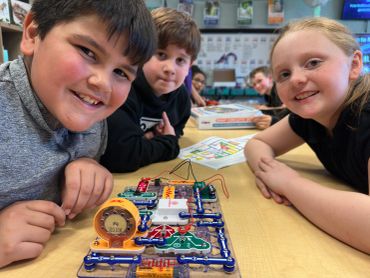
- Core Focus: Balanced and unbalanced forces, motion patterns, and magnetic or electric interactions.
- Summary: Students investigate how pushes and pulls affect the motion of an object, learn to measure and predict patterns of motion, and explore non-contact forces through magnetism and static electricity. They also apply scientific ideas to design a simple solution using magnets.
2. Life Science: Organisms, Life Cycles, and Traits
- Core Focus: Plant and animal life cycles, group behavior, heredity, and environmental influence.
- Summary: Students use models to study the unique and diverse life cycles of animals and flowering plants. They examine how social group behaviors help organisms survive, how traits are inherited or acquired, and how environmental factors influence organism traits and survival.
3. Biological Evolution and Fossils (Life Science)
- Core Focus: Evidence of past life, trait variations, and adaptation.
- Summary: Students analyze fossils as evidence of organisms that lived long ago. They explore how variations in traits among a species provide advantages for survival and how changes in an environment affect organisms over time.
4. Earth's Weather and Climate Patterns (Earth and Space Science)
- Core Focus: Weather data, regional climate patterns, and prediction.
- Summary: Students collect, organize, and interpret weather data to describe typical seasonal conditions and climate patterns across different regions of the world.
5. Earth and Human Activity: Weather Hazards (Earth and Space Science)
- Core Focus: Engineering and design solutions for natural hazards.
- Summary: Students examine severe weather-related hazards (such as floods, strong winds, or storms) and make evidence-based claims about the effectiveness of engineering or design solutions built to reduce the impact of these hazards on humans.
Physical Science: Forces & Interactions

Life Science - Molecules to Organisms
Weather Patterns & Climate
Experiments & Projects Gallery